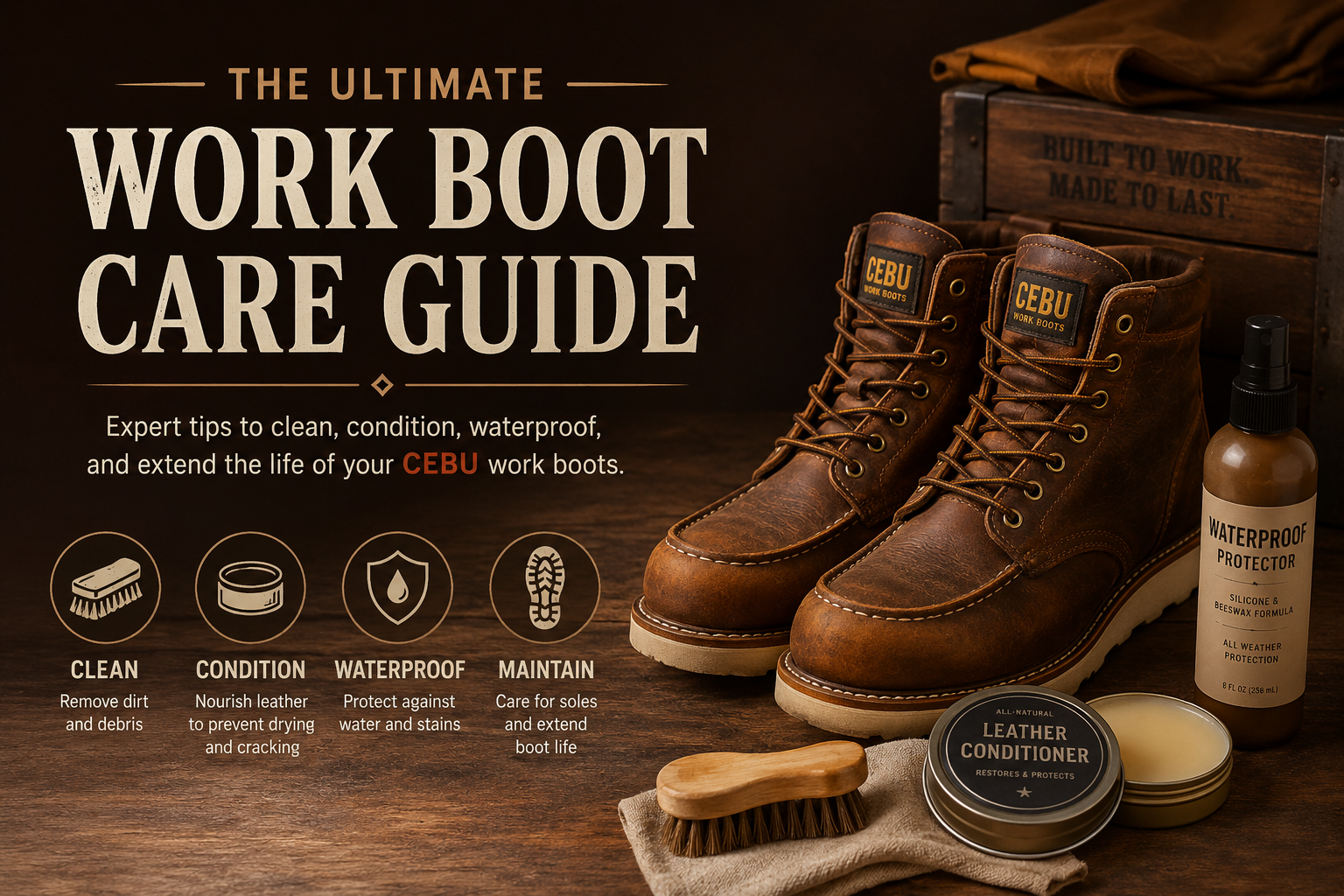
Your work boots face more punishment in a single week than most shoes see in a lifetime — oil, mud, concrete, chemicals, and thousands of steps under full load. With the right care routine, a quality pair of CEBU boots can last 3 to 5 years or more. This guide covers everything: cleaning, conditioning, waterproofing, storage, and knowing when it's time for a new pair.
1. Why Boot Care Matters
Work boots are a serious investment — and like any investment, they reward consistent attention. Leather is a natural material that dries out, cracks, and deteriorates when exposed to moisture, dirt, and UV rays without proper care. A boot that's never conditioned can crack within a year; the same boot properly maintained can outlast multiple lesser pairs.
Beyond longevity, well-maintained boots perform better. Clean, supple leather flexes correctly, supporting your ankles and arches the way the boot was designed to. A dirty, stiff upper can create pressure points, reduce breathability, and diminish the safety features your boots were built around.
Spending just 5 minutes after every shift — brushing off dirt and wiping the leather — can reduce your total maintenance time by 80% and extend boot life significantly.
2. Daily Cleaning Routine
A consistent end-of-day habit keeps dirt from embedding into the leather grain and protects your investment without much effort.
- Remove boots and bang the soles together to dislodge loose mud and debris.
- Use a stiff-bristled boot brush to scrub off dirt from the upper, welt, and lugs of the sole.
- Wipe the leather with a slightly damp cloth to remove dust and surface grime.
- Remove insoles and set them out to air dry separately.
- Loosen laces and open the boots wide so air can circulate inside overnight.
- Store in a cool, dry place — away from direct sunlight and heat vents.
Placing wet boots next to a heater, in a dryer, or in direct sunlight causes the leather to shrink and crack. Always air dry at room temperature, even if it takes 12–24 hours.
3. Deep Cleaning Step-by-Step
Perform a thorough deep clean every 2–4 weeks depending on how hard your work environment is. Here's the full process:
-
Remove laces and insoles Wash laces separately in warm water with a little soap. Set insoles aside to air out.
-
Dry-brush first Use a stiff horsehair or nylon boot brush to remove all dry dirt from the upper, seams, welt, and outsole. Don't skip this — wet cleaning on muddy leather just smears the dirt deeper.
-
Apply leather cleaner Use a dedicated leather cleaner (or a saddle soap) with a damp cloth or soft brush. Work in circular motions. Avoid soaking the leather.
-
Clean the welt and sole edges Use a small brush or old toothbrush to scrub the welt seam and sole edges where grime accumulates.
-
Wipe clean and air dry Remove all soap residue with a clean damp cloth. Allow boots to dry fully at room temperature — typically 4 to 8 hours. Insert cedar shoe trees or newspaper to help hold shape.
-
Condition while leather is still slightly warm Apply conditioner once fully dry. Warm leather absorbs conditioning oils more effectively.
4. Leather Conditioning
Conditioning replaces the natural oils that daily use, water, and cleaning strip away. Think of it as moisturizer for your boots. Without it, leather becomes brittle and cracks — especially around the vamp, toe box, and ankle flex points.
How Often to Condition
- Light use (office, occasional field work): Every 4–6 weeks
- Moderate use (daily outdoor work): Every 2–3 weeks
- Heavy use (construction, wet environments): Weekly
- After any soaking or deep clean: Always condition before next use
Every pair of CEBU boots ships with a leather cream care kit. Use it as your primary conditioner — it's formulated specifically for the leather grades used in CEBU boots.
How to Apply Conditioner
- Start clean — only condition a clean boot. Conditioning over dirt seals grime into the leather.
- Apply a small amount to a soft cloth or sponge. A little goes a long way — about a quarter-sized dab per boot.
- Work in circles across the entire upper, paying extra attention to the toe, heel counter, and ankle fold areas.
- Let it absorb for 15–30 minutes before wiping off any excess with a clean cloth.
- Buff lightly with a horsehair brush to restore a subtle shine and close the leather pores.
5. Waterproofing Your Boots
Even naturally water-resistant full-grain leather benefits from a waterproofing treatment, especially if you regularly work in wet conditions. Proper waterproofing keeps your feet dry and prevents the leather from becoming saturated (which weakens it over time).
| Product Type | Best For | Preserves Look? | Durability |
|---|---|---|---|
| Beeswax cream | Smooth full-grain leather | ✓ Slight darkening | 6–8 weeks |
| Silicone spray | All leather types | ✓ No color change | 2–4 weeks |
| Wax-based polish | Dress/work boots | ✓ Adds shine | 4–6 weeks |
| Fluoropolymer spray | Nubuck & suede | ✓ Invisible | 3–5 weeks |
| Neatsfoot oil | Very dry/cracked leather | ✗ Darkens leather | 8–10 weeks |
Any time your boots get seriously wet, the waterproofing treatment is partially depleted. After drying fully, re-apply your waterproofing product before your next wet-environment shift.
6. Breaking In New Work Boots
Quality leather work boots require a break-in period as the leather molds to the shape of your foot. Rushing this process leads to painful blisters and pressure points. Here's how to break in new boots correctly:
- Day 1–3: Wear your new boots for 2–3 hours around the house or on lighter duties. Thick wool socks help cushion pressure points.
- Day 4–7: Increase to 4–5 hours per day. Watch for consistent hot spots and apply moleskin padding if needed.
- Week 2: You should be comfortable enough for full shifts. Lace tightness matters — experiment to find what relieves any heel slip.
- Apply conditioner on Day 1: A light coat of conditioner before first wear softens the leather and accelerates the break-in process.
- Alternate with another pair: If possible, alternate daily between your new and old boots. This gives the leather time to dry and recover between wears.
Merino wool or moisture-wicking synthetic socks reduce friction during break-in and keep your feet drier throughout the workday. Avoid 100% cotton socks — they hold moisture against your skin.
7. Sole & Insole Maintenance
The outsole and insole are often overlooked, but they're central to foot comfort and boot longevity.
Caring for CEBU's Dual-Density Outsoles
CEBU's Max sole combines two polyurethane materials — one for durability in high-wear zones, one for cushioning. To care for it:
- Rinse mud and debris from the lug pattern after every use to prevent traction degradation.
- For oil or chemical contamination, scrub with a stiff brush and mild soap, then rinse thoroughly.
- Inspect the welt seam periodically. Any separation should be re-cemented before it worsens.
- Avoid walking on super-heated surfaces (metal grates in summer, etc.) which can prematurely harden polyurethane.
Insole Care
CEBU boots include an extra pair of insoles. Get the most from both pairs:
- Remove insoles daily and allow them to air dry to prevent odor-causing bacteria.
- Sprinkle baking soda inside the boot after removing insoles for overnight odor control.
- Rotate between the two pairs weekly to let each fully dry and recover.
- Replace insoles every 6–12 months, or when the cushioning has flattened noticeably.
8. Seasonal Care Tips
Summer
Re-apply waterproofing monthly. Condition leather more frequently in dry heat. Rotate between two pairs to allow full drying between shifts.
Fall
Deep clean and fully waterproof before rainy season begins. Inspect welt seam integrity. Replace insoles if worn down heading into cold months.
Winter
Salt and de-icers are leather's worst enemies. Wipe boots with damp cloth after every use to prevent salt crystals from drying into the leather grain.
Spring
Perform a full deep clean after winter. Re-condition heavily. Inspect for winter damage (cracked toe box, welt separation) and address before mud season.
Road salt leaves white crystalline deposits that draw moisture out of leather as they dry, causing micro-cracks. Wipe it off the same day — don't let it dry on the boot.
9. Steel Toe vs. Composite Toe: Which Is Right for You?
CEBU offers both steel toe and composite toe options across their boot lineup. Understanding the difference helps you choose the right protection for your work environment.
| Feature | Steel Toe | Composite Toe |
|---|---|---|
| Impact protection | ✓ Maximum — ASTM F2413 rated | ✓ Excellent — ASTM F2413 rated |
| Weight | Heavier | 20–30% lighter |
| Metal detectors | ✗ Triggers alarms | ✓ Non-metallic, passes through |
| Temperature extremes | Conducts cold/heat | ✓ Insulating — stays neutral |
| Electrical hazard | ✗ Conductive | ✓ Non-conductive |
| Best for | Heavy industrial, warehouse, manufacturing | Electrical work, airports, cold environments |
10. Featured CEBU Work Boots
Browse our most popular styles built for real work. Each comes with an extra pair of insoles and leather cream care kit included.
CEBU Max Wellington — Steel Toe
Dual-density Max sole, full-grain leather upper. The 25-year favorite for heavy industrial environments.
Shop Now →Farmer Wellington — Soft Toe
Shark Shield heel & toe reinforcement, double-density sole. Western comfort for all-day wear.
Shop Now →Farmer Wellington — Steel Toe
Shark Shield technology meets steel toe protection. Oil and acid resistant, air flow insole.
Shop Now →Ranger Brown Wellington
Durable leather upper, EVA-rubber sole, steel toe with metallic blue accents. Built for construction.
Shop Now →CEBU Men's Ultra 300 — Final Sale
Ultra-lightweight construction at an unbeatable price. Free UPS Ground shipping included.
Shop Now →CEBU Waterproof Composite Toe
Premium waterproof construction with non-conductive composite toe. Ideal for electrical hazard environments.
Shop Now →11. Frequently Asked Questions
Quick answers to the most common work boot questions from our customers.